
 Solar system
Venus- The hotspot
Venus- The hotspot Venus is the second closest planet from the sun . Venus is the planet that we can see and observe by our nacked eyes. It is one of the brightest objects in the sky during the evening sky. It was named after the Roman goddess Venus, the goddess of love and beauty. venus source: NASA Venus is similar to earth in many ways such as …
Read more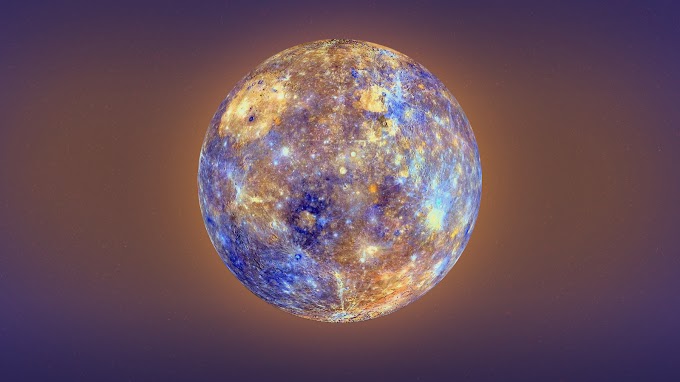 Solar system
THE MESSENGER OF GOD - MERCURY
About Mercury "Mercury" In Roman, the mercury is known as the messenger of God. Mercury is the nearest planet from the sun . The mercury is the smallest planet in our solar system . It has a similar surface as the moon has as it has rocky, barren, and craters too. Size comparison as the USA to planet Mercury. Some facts about the Mercu…
Read more Solar system
Moon: Our neighbour
Moon: Our neighbour Introduction: moon Mankind is very fascinated about our space neighbour moon. We, humans, are very curious about the moon since our ancient times. Moon is our natural satellite. It is revolving around us. Moon is a dry and dusty celestial object and the cause of tidal activities on earth. Some facts: The …
Read more Solar system
Our home: Earth
Our Home: Earth Our earth is the third planet in our Solar System . Earth is the fifth largest planet. "The Blue Marble" Earth is also known as Tellus in Roman mythology, etc. The Earth is the third rock planet from our Sun and the only planet with known life on it. The planet is known to have an atmosphere containing free oxygen, oceans of water …
Read more sun
sun
Solar System : Origin
Origin of Our Solar System Solar System: where I am? You can find me in one of the four outer spiral arms of Milky Way which is known as Orion's arm. I am 27,000 light-years away from the center of Milky Way. It took years to complete one revolution around the center in my orbit. Solar system How I formed? I formed nearly 4.5 billion years ago…
Read more sun
sun
Sun: our power source
Sun: Introduction Sun is one of the billion stars in this universe. It is an ultimate source of energy on earth. Sun Structure of Sun Sun consists of 91.0% of hydrogen (H) and 8.9% of helium (He), remaining is other heavy elements by volume. By mass, the sun is consists of 70.6% hydrogen and 27.4% helium. The Sun has six regions: the core, the radiative zone…
Read more mysteries of univers
Black hole: Bermuda triangle of Univers
Blackhole They are the most mysterious things in the entire universe. Its gravitational pull is so strong that even the fastest thing of Universe the light rays can not escape that gravitational pull. Blackhole swallowing matter Black holes are formed when an aged star dies and shrinks so much that all its mass is becomes point sized so by Newton's la…
Read more Universe
Solar System: Introduction
Solar system Our solar system is a system of 8 planets and some dwarf planets like Pluto, asteroid belt all are orbiting around the SUN. Planets of the solar system Mercury Venus Earth Mars Jupiter Saturn Uranus Neptune Pluto(dwarf planet) Solar System For more information on each planet follow my blog and comment and give your suggestion…
Read more Univers
Bigbang: The birth of Univers
Big bang When we see the world and space outside we were confused that how this universe is firmed. There are many theories given by scientists to answer this mystery, but the theory that was accepted by most of the astrophysicists is The theory of the big bang. About the big bang The theory states that there was an egg-like structure that consists of …
Read more



Follow Us Here